Data Analyst Skills: 12 Skills You Need in 2026
The most important data analyst skills include Excel, SQL, data cleaning, statistics, Power BI, data visualization, Python, analytical thinking, communication, business understanding, AI literacy and problem-solving. You do not need to master everything at once; start with the core skills and build through projects.
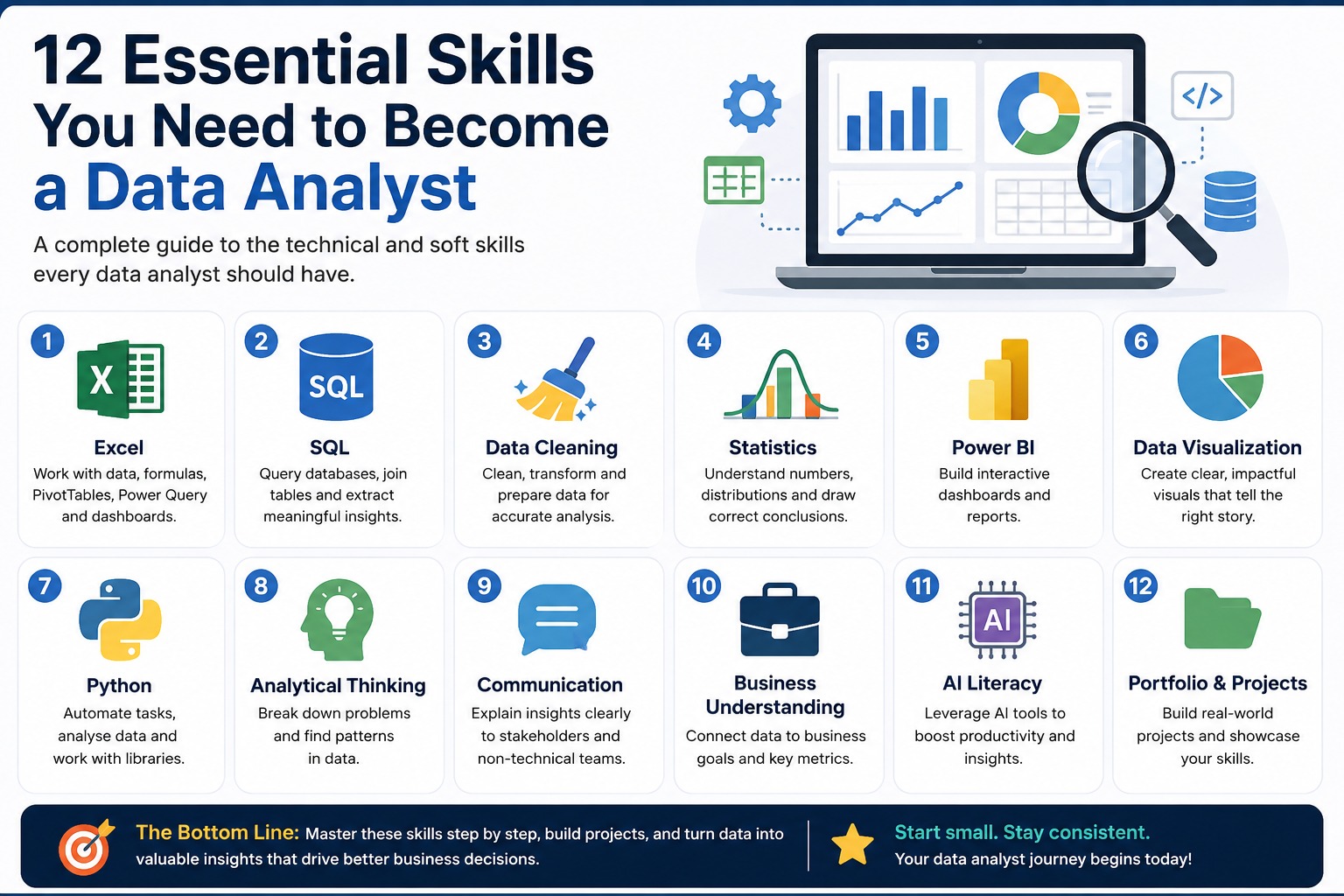
What skills are required to become a data analyst?
A data analyst needs a mix of technical, analytical and communication skills. The core technical skills include Excel, SQL, data cleaning, statistics, Power BI or another visualization tool, and increasingly Python. Strong analysts also know how to frame business questions, explain findings clearly and turn data into useful recommendations.
A data analyst's job is not simply to create charts or write SQL queries. The real job is to take a business question, find and prepare the right data, analyse it, identify useful patterns and communicate what the business should do next.
Microsoft describes data analysts as professionals who prepare, clean and transform data, build models, create visualizations and work with stakeholders to turn data into meaningful insights.
Data analyst skills at a glance
| Skill | Why it matters | Priority for beginners |
|---|---|---|
| Excel | Cleaning, analysis and reporting | Essential |
| SQL | Querying databases | Essential |
| Data Cleaning | Makes analysis reliable | Essential |
| Statistics | Helps interpret results correctly | Essential |
| Power BI | Dashboards and reporting | Essential |
| Data Visualization | Communicating insights | Essential |
| Analytical Thinking | Solving business problems | Essential |
| Communication | Explaining findings | Essential |
| Python | Automation and advanced analysis | Important |
| Business Understanding | Connecting data to decisions | Important |
| AI Literacy | Faster analysis and productivity | Growing |
| Portfolio Projects | Demonstrates practical ability | Essential |
1. Advanced Excel
Excel is still one of the most practical data analyst skills for beginners and working professionals.
You should go beyond basic formulas and learn:
- XLOOKUP and lookup functions
- IF, SUMIFS and COUNTIFS
- PivotTables and PivotCharts
- Data cleaning
- Conditional formatting
- Power Query
- Dashboards
- Basic automation
Excel is particularly useful for business reporting, MIS, finance, sales and operations.
TechnoExcel's Advanced Excel with Gen AI training focuses on formulas, Power Query, PivotTables, dashboards, automation and AI-assisted Excel workflows.
2. SQL
SQL is one of the most important technical skills for a data analyst because it allows you to retrieve and analyse information stored in databases.
At a minimum, learn:
- SELECT
- WHERE
- GROUP BY
- ORDER BY
- HAVING
- JOINs
- Subqueries
- CTEs
- Aggregate functions
- Window functions
For example, a company may store customer, sales and product information in separate database tables. An analyst uses SQL to combine that information and answer questions such as:
Which products generated the highest revenue last quarter?
Learning SQL means learning how to ask questions of data, not just memorising commands.
3. Data Cleaning and Preparation
Data cleaning is a core data analyst skill because real-world datasets are rarely ready for analysis.
You may encounter:
- Missing values
- Duplicate records
- Incorrect dates
- Inconsistent names
- Wrong data types
- Blank rows
- Formatting errors
Tools such as Excel Power Query, SQL and Python can help analysts clean and transform data before analysis.
Microsoft's current Power BI training specifically includes profiling data, handling inconsistencies and transforming data before analysis.
4. Statistics
Statistics helps a data analyst decide whether a pattern in the data is meaningful or misleading.
You should understand:
- Mean, median and mode
- Range and standard deviation
- Percentages
- Probability basics
- Distributions
- Correlation
- Regression basics
- Hypothesis testing
You don't need advanced mathematics to begin a data analyst career. But you should understand what your calculations mean and when to use them.
5. Power BI and Data Visualization
Power BI helps analysts turn prepared data into interactive dashboards and reports that business users can understand.
Important Power BI skills include:
- Connecting data sources
- Power Query
- Data transformation
- Data modelling
- Relationships
- DAX
- Measures
- Interactive dashboards
- Report design
- Power BI Service
Microsoft's current Power BI Data Analyst certification measures four major areas: preparing data, modelling data, visualizing and analysing data, and managing/securing Power BI.
TechnoExcel's Power BI Mastery program covers Power Query, data modelling, DAX, dashboards, Power BI Service and reporting.
6. Analytical Thinking
Analytical thinking is what turns a tool user into a data analyst.
Before opening Excel or writing SQL, ask:
- What problem are we trying to solve?
- What data do we need?
- What could explain the result?
- What does the data actually show?
- What action should the business consider?
For example, if sales fall by 15%, don't immediately build a chart.
First ask:
Did sales fall across every region, or only one?
That question changes the entire analysis.
7. Data Storytelling
Data storytelling means explaining what the numbers mean, why they matter and what someone should do next.
A dashboard full of charts isn't automatically a good dashboard.
A strong analyst can say:
“Sales declined mainly because the South region lost repeat customers in Q3.”
That is more useful than simply saying:
“Sales decreased 15%.”
Google's Data Analytics Certificate also includes data storytelling and visualization as core learning areas.
8. Python for Data Analytics
Python is an important skill for analysts who want to automate repetitive work or handle analysis that becomes difficult in spreadsheets.
For data analytics, focus on:
- Python fundamentals
- Pandas
- NumPy
- Matplotlib
- Seaborn
- Jupyter Notebook
- Data cleaning
- Data manipulation
You don't necessarily need advanced Python before applying for an entry-level analyst role. But adding Python can expand your options.
TechnoExcel's Python for Data Analytics course focuses on Pandas, NumPy, visualization, data manipulation and automation.
9. Business Understanding
Business understanding helps analysts turn technically correct analysis into useful business recommendations.
Learn basic concepts such as:
- Revenue
- Profit
- Cost
- Conversion rate
- Customer retention
- Inventory
- Productivity
- KPIs
The same dataset can lead to very different questions depending on the industry.
A marketing analyst may focus on conversion and customer acquisition. A manufacturing analyst may focus on production, quality and downtime.
10. Communication and Stakeholder Skills
Communication is essential because analysts rarely work alone.
You may need to explain findings to:
- Managers
- Finance teams
- Sales teams
- HR
- Operations
- Product teams
- Senior leadership
The best analysts don't overwhelm stakeholders with technical language. They explain complex findings in simple business terms.
11. AI Literacy
AI literacy is becoming an important addition to the data analyst skill set, but AI should support analytical thinking rather than replace it.
Analysts can use AI tools to:
- Generate formula ideas
- Explain SQL
- Suggest analysis approaches
- Draft code
- Explore datasets
- Improve documentation
- Brainstorm visualizations
Google's current Data Analytics Certificate includes practical AI use for data cleaning, structuring, formulas and visualization ideas.
The important skill is knowing when to trust, verify and correct AI-generated output.
12. Portfolio and Project Skills
Projects prove that you can apply data analyst skills to real problems.
A strong beginner portfolio could include:
| Project | Tools |
|---|---|
| Sales dashboard | Excel + Power BI |
| Customer analysis | SQL + Power BI |
| Marketing analysis | Excel + SQL |
| Customer churn | Python + Power BI |
| Inventory analysis | SQL + Excel |
Don't simply upload screenshots.
For each project, explain:
Business problem → Data → Cleaning → Analysis → Insight → Recommendation
That shows employers how you think.
What should you learn first to become a data analyst?
Start with Excel and analytical thinking, then learn SQL, statistics and Power BI before adding Python. This sequence gives beginners a practical foundation without trying to learn every tool at the same time.
A practical learning roadmap
- Stage 1 - Foundation: Excel + basic statistics
- Stage 2 - Data querying: SQL
- Stage 3 - Visualization: Power BI + data storytelling
- Stage 4 - Advanced analysis: Python + statistics
- Stage 5 - Job readiness: Projects + portfolio + interview practice
This sequence is also close to the practical progression used by current training and certification ecosystems, although the exact tool order can vary by role. Google, for example, teaches spreadsheets, SQL, visualization and programming within its analytics curriculum, while Microsoft emphasizes preparation, modelling, visualization and analysis in its Power BI analyst pathway.
Which skills are most important for freshers?
For a beginner, Excel, SQL, Power BI, basic statistics, analytical thinking and communication should come first. Python is valuable, but you don't need to master every advanced programming concept before starting your first analytics role.
The goal is not:
“I know 20 tools.”
The goal is:
“I can take messy data, analyse it and explain what the business should do.”
Common mistakes beginners make
Learning too many tools
Don't learn Tableau, Power BI, Python, R, SQL, Excel and machine learning simultaneously.
Ignoring SQL
Knowing dashboards without knowing how to retrieve data can limit your analytics capability.
Avoiding statistics
You don't need advanced mathematics, but you need enough statistics to interpret results correctly.
Building only tutorial projects
A copied YouTube dashboard doesn't show much problem-solving ability.
Focusing only on certificates
Certificates can support your profile, but practical projects demonstrate what you can actually do.
Frequently Asked Questions
What are the most important data analyst skills?
The core skills are Excel, SQL, data cleaning, statistics, Power BI, visualization, analytical thinking and communication. Python, AI literacy and business understanding become increasingly useful as you progress.
Is Excel necessary for a data analyst?
Excel is highly useful for data analysts, particularly in reporting, operations, finance and business analysis. Advanced Excel skills such as PivotTables, Power Query and lookup functions provide a strong foundation.
Is SQL necessary to become a data analyst?
SQL is one of the most valuable technical skills for data analysts because many organizations store business data in relational databases.
Do data analysts need Python?
Not always for entry-level roles, but Python is increasingly useful for automation, larger datasets and advanced analysis.
Can I become a data analyst without a computer science degree?
Yes. Data analytics can be entered from different educational backgrounds. Practical skills, projects and the ability to solve business problems are important alongside formal education.
What should I learn first: Excel, SQL or Python?
For most beginners, starting with Excel and then moving to SQL is a practical approach. Add Power BI and statistics next, then Python for deeper analysis and automation.
How long does it take to learn data analyst skills?
The timeline depends on your starting point, study time and target role. A focused learner can build foundational skills in several months, but becoming job-ready also requires hands-on projects and practice.
Which Power BI skills should a data analyst learn?
Focus on Power Query, data modelling, relationships, DAX, measures, visualization, dashboard design and Power BI Service.
What projects should a fresher build?
Build projects around real business questions such as sales performance, customer churn, inventory, finance or marketing. Show the complete process from raw data to recommendation.
Are soft skills important for data analysts?
Yes. Communication, critical thinking, business understanding and stakeholder management help analysts turn technical findings into decisions.
Conclusion: Which data analyst skills should you learn?
Becoming a data analyst is not about memorising a long list of tools.
Build the fundamentals first:
Excel → SQL → Statistics → Power BI → Python → Projects
Then strengthen your analytical thinking, communication, business understanding and AI skills.
If you want a structured path instead of learning these tools separately, explore TechnoExcel's Data Analytics program, which combines Excel, SQL, Python, Power BI, statistics and real business datasets in one program.
This topic is covered in the Excel and Power BI course. Sessions are live, practical and taught with real business data — a natural next step if this article matches what you are working on.