Is Python Still Worth Learning in 2026? AI, Jobs & Career Scope
Yes, Python is still worth learning in 2026. AI has not made Python irrelevant; it has changed how Python is used, making skills such as data analysis, automation, AI integration, debugging and problem-solving more valuable than simply knowing syntax.
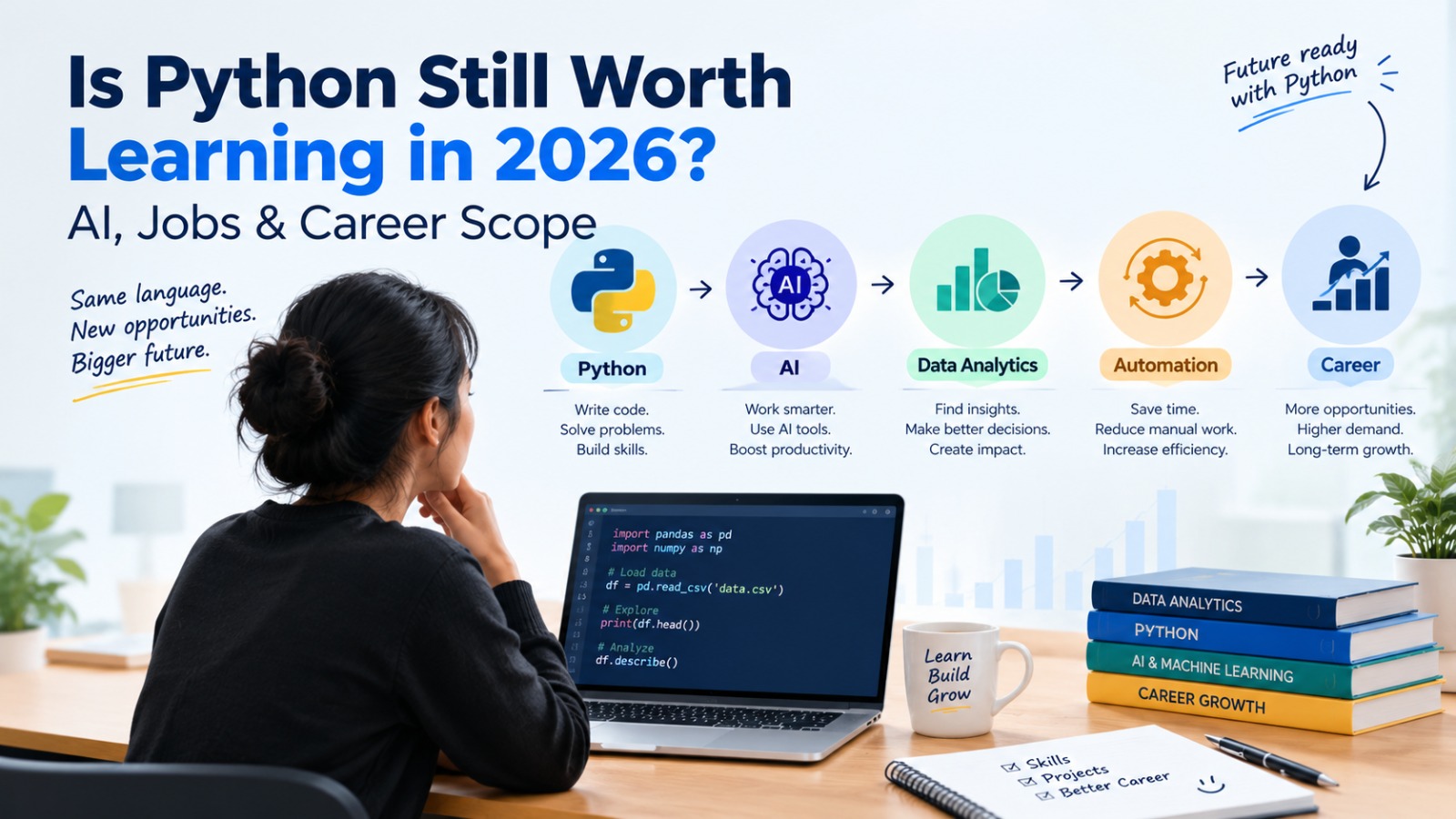
Is Python Still Worth Learning in 2026?
Yes, Python is still worth learning in 2026, especially if you want to work in data analytics, artificial intelligence, automation, software development, machine learning or backend development.
What has changed is the skill level employers expect. Knowing basic Python syntax is no longer enough. AI tools can generate simple code quickly, so professionals now need to understand the code, check whether it works, fix errors and apply it to real business problems.
Python's relevance is also supported by current developer trends. Its adoption increased significantly in the 2025 Stack Overflow Developer Survey, while GitHub reported strong Python growth in AI and data-focused development.
Why Is Python Still Popular in 2026?
Python remains popular because one language can support many different types of work.
| Area | How Python is used |
|---|---|
| Data Analytics | Cleaning, analysis and visualization |
| Artificial Intelligence | AI applications and model development |
| Machine Learning | Building and testing ML models |
| Automation | Repetitive business and technical tasks |
| Web Development | Backend applications and APIs |
| Data Science | Statistics, modeling and experimentation |
| Testing | Automated software testing |
| Education | Programming and technical learning |
This flexibility is one of Python's biggest advantages. You can start with basic programming and later move into analytics, automation, AI or software development without learning an entirely different language.
What Has AI Changed About Learning Python?
AI has changed how people write code, but it has not removed the need to understand code.
Tools such as AI coding assistants can generate functions, explain errors, suggest approaches and create first drafts of scripts. That makes coding faster, but generated code can still contain incorrect logic, security problems, inefficient approaches or assumptions that do not match the actual business requirement.
The valuable skill in 2026 is therefore not just:
“Can you write Python?”
It is:
“Can you use Python and AI together to solve a real problem and verify the result?”
Will AI Replace Python Developers?
No, AI is more likely to change Python development than eliminate it.
AI can automate parts of coding, especially repetitive code generation. But someone still needs to understand requirements, choose the right approach, review generated code, test it, handle edge cases and connect the solution to a real system.
This is already visible in developer research. Stack Overflow's 2025 survey found widespread AI-tool adoption, but also significant frustration with AI-generated answers that are nearly correct and require debugging. That creates a stronger need for people who understand what the code should actually do.
The same principle applies to data analysts. AI can generate a Pandas query, but an analyst still needs to know whether the calculation answers the right business question.
What Python Skills Are Actually Worth Learning in 2026?
You do not need to learn every Python feature before you can use Python professionally.
Focus on skills that solve real problems.
Python fundamentals
Learn:
- Variables and data types
- Lists, dictionaries and tuples
- Conditions
- Loops
- Functions
- Modules
- Error handling
- File handling
These concepts form the foundation for almost every Python workflow.
Python for data analysis
If your goal is data analytics, prioritize:
- Pandas
- NumPy
- Matplotlib
- Seaborn
- Jupyter Notebook
- Data cleaning
- Data transformation
- Exploratory data analysis
- Data visualization
Pandas is especially important because it allows you to work with structured datasets using DataFrames.
Python for automation
Automation is another practical reason to learn Python.
You can use Python to:
- Combine multiple Excel files
- Clean recurring reports
- Rename files
- Process CSV files
- Generate reports
- Connect to APIs
- Automate repetitive calculations
- Schedule recurring tasks
For a professional who spends several hours every week repeating the same process, even a small Python script can create measurable value.
Python for AI
Python is also deeply connected to the AI ecosystem.
Depending on your career goal, you may eventually work with:
- Machine learning
- Natural language processing
- Generative AI
- LLM applications
- APIs
- AI agents
- Data preprocessing
- Model evaluation
You do not need to start with machine learning. Build your Python foundation first and then choose a specialization.
Is Python Useful for Data Analytics in 2026?
Yes. Python is particularly useful for analysts who want to move beyond spreadsheet-based analysis.
Python can help when you need to work with larger datasets, repeat the same analysis frequently, combine multiple files or perform transformations that become difficult to manage manually.
However, Python does not replace Excel, SQL or Power BI.
A practical analytics workflow may look like:
Excel → SQL → Python → Power BI
For example, SQL can retrieve the required records, Python can clean and analyze the data, and Power BI can turn the final results into an interactive dashboard.
Excel still has an important role in reporting and business analysis.
Python vs AI Tools: What Should You Learn?
You should learn Python and AI tools together, not treat them as competing skills.
| Python gives you | AI tools give you |
|---|---|
| Programming fundamentals | Faster code generation |
| Control over logic | Code explanations |
| Debugging ability | First-draft solutions |
| Data manipulation | Faster experimentation |
| Automation | Productivity support |
| Technical understanding | Assistance with unfamiliar tasks |
Think of AI as a productivity tool rather than a replacement for technical understanding.
If an AI tool generates 100 lines of Python, you should be able to inspect those lines and identify whether the result is correct.
What Jobs Can You Get With Python?
Python is not limited to one job title.
| Career path | Additional skills to learn |
|---|---|
| Python Developer | APIs, Django/FastAPI, databases |
| Data Analyst | SQL, Excel, Power BI, statistics |
| Data Scientist | Statistics, ML, Pandas, Scikit-learn |
| Machine Learning Engineer | ML, deployment, cloud, software engineering |
| Automation Engineer | APIs, scripting, testing |
| Backend Developer | Django/FastAPI, SQL, cloud |
| AI Engineer | Python, APIs, LLMs, ML frameworks |
| Data Engineer | SQL, Python, databases, cloud |
This is why learning Python can be valuable even if you do not ultimately become a “Python Developer.”
For example, someone interested in business analytics may use Python mainly for automation and advanced data analysis.
Is Python a Good Career in India in 2026?
Python continues to be relevant in India's technology and analytics market because it supports several growing areas, including AI, data and software development.
But learning Python alone does not guarantee a job.
The stronger approach is to combine Python with a role-specific skill set.
For example:
- Data Analyst:Python + SQL + Excel + Power BI + Statistics
- AI/ML:Python + Statistics + Machine Learning + AI frameworks
- Backend:Python + APIs + Django/FastAPI + SQL + Cloud
- Automation:Python + APIs + scripting + databases + workflow tools
The career value comes from the combination, not the programming language by itself.
How Long Does It Take to Learn Python?
You can learn Python basics in a few weeks, but becoming professionally useful takes longer.
A practical progression looks like this:
| Stage | Focus |
|---|---|
| Weeks 1–3 | Python fundamentals |
| Weeks 4–6 | Functions, files and problem-solving |
| Weeks 7–10 | Pandas, NumPy and data handling |
| Weeks 11–14 | Visualization and real datasets |
| Weeks 15+ | Projects, automation and role-specific skills |
The timeline depends on your background and practice time. Someone learning for one hour every day will progress differently from someone practicing only on weekends.
The important point is to build projects while learning instead of waiting until you “finish Python.”
What Should You Build After Learning Python?
Projects are more useful than a long list of completed tutorials.
For data analytics, you could build:
- Sales performance analysis
- Customer churn analysis
- Marketing campaign analysis
- Inventory analysis
- Excel report automation
- Customer segmentation
- Monthly business reporting automation
For each project, explain:
Business problem → Data → Cleaning → Analysis → Finding → Recommendation
This shows employers that you can use Python to solve problems rather than simply write code.
Common Mistakes When Learning Python in 2026
Avoid these mistakes:
- Learning syntax without building projects
- Trying to master every Python library
- Depending completely on AI-generated code
- Jumping into machine learning too early
- Ignoring SQL and databases
- Ignoring statistics for analytics roles
- Building projects with no business question
- Assuming a certificate alone will get you hired
- Learning Python without choosing a career direction
The biggest mistake is learning Python as an isolated skill.
Your target should be a career skill stack.
Who Should Learn Python in 2026?
Python is a strong choice if you are:
- A student exploring technology careers
- A working professional moving into analytics
- An Excel user who wants to automate work
- An aspiring data analyst
- Interested in AI or machine learning
- Interested in backend development
- Looking to automate repetitive tasks
- Planning a career switch into a technical role
Python may not be the best first language for every person. If your goal is primarily frontend web development, native mobile development or a highly performance-focused system, another language may be more directly relevant.
The right language depends on the career you want.
Python Learning Roadmap for 2026
A practical roadmap is:
- Step 1: Learn Python fundamentals
- Step 2: Choose a career direction
- Step 3: Learn role-specific libraries and tools
- Step 4: Work with real datasets or projects
- Step 5: Use AI tools to improve productivity
- Step 6: Build a portfolio
- Step 7: Apply your skills to real business problems
For aspiring data analysts, a practical path is:
Excel → SQL → Python → Power BI → Statistics → Projects
This gives you a broader analytics skill set than learning Python alone.
Frequently Asked Questions About Python in 2026
Is Python still worth learning in 2026?
Yes. Python remains highly relevant in AI, data analytics, automation, machine learning and software development. Its value is strongest when combined with practical problem-solving and role-specific skills.
Will AI replace Python developers?
AI is changing development work, but it does not remove the need for developers who can understand requirements, review code, debug problems and build reliable solutions.
Is Python dying because of AI?
No. Current developer and GitHub data shows strong Python adoption in AI and data-focused development. AI has increased the importance of Python in many technical workflows.
Should I learn Python or AI first?
Learn Python fundamentals first if you want to build technical depth. Then use AI tools alongside Python to improve productivity, learn faster and experiment with code.
Is Python good for data analytics?
Yes. Python is useful for data cleaning, analysis, visualization and automation. It works especially well alongside SQL, Excel and Power BI.
Can I get a job after learning Python?
Python can support several career paths, but the language alone is rarely enough. Add role-specific skills, practical projects and the ability to solve real problems.
How long does it take to learn Python?
Basic Python can be learned in weeks, while becoming professionally useful usually requires several months of consistent practice and project work.
What Python libraries should beginners learn?
For general programming, start with the standard language fundamentals. For analytics, prioritize Pandas and NumPy, followed by Matplotlib and Seaborn.
Is Python useful for working professionals?
Yes. Working professionals can use Python for data analysis, automation, reporting, file processing and repetitive business tasks without becoming full-time software developers.
What should I learn after Python?
Choose based on your goal. Data analysts can add SQL, Excel, Power BI and statistics. AI learners can move toward machine learning and AI frameworks. Developers can learn APIs, databases and cloud technologies.
Final Verdict: Is Python Worth Learning in 2026?
Yes — but learn it differently.
The old approach was to memorize Python syntax and complete dozens of coding exercises. The better approach in 2026 is to learn Python as a tool for solving problems.
Combine Python with AI, data, SQL, Excel, Power BI, automation or software development, depending on your career goal.
AI can write code. The valuable professional is the person who knows what code to ask for, whether the result is correct, how to fix it and how to use it to solve a real problem.
If your goal is data analytics, TechnoExcel's Python for Data Analytics program focuses on Pandas, NumPy, Matplotlib, Seaborn, data preparation, DataFrame operations, automation and real business datasets. It is designed for professionals who want to go beyond what Excel can handle.
This topic is covered in the Python for Data Analytics course. Sessions are live, practical and taught with real business data — a natural next step if this article matches what you are working on.