Data Analytics Skills in Oman: Future Workforce Guide
Data analytics skills in Oman are becoming increasingly relevant as businesses adopt digital tools and data-driven decision-making. Professionals can build future-ready capabilities by learning Excel, Power BI, SQL, Python, data visualisation, AI and business problem-solving.
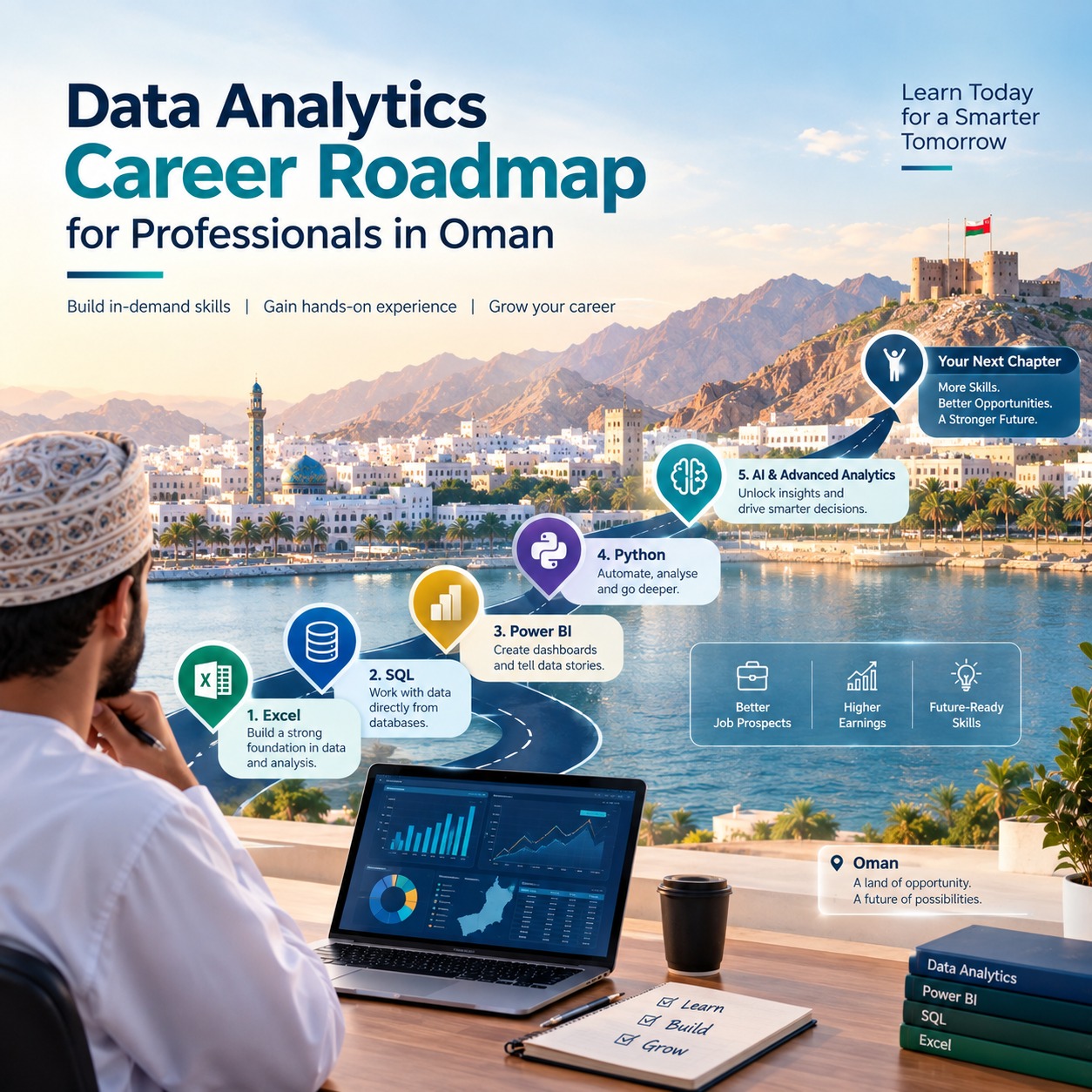
Data analytics skills in Oman are becoming increasingly relevant as businesses adopt digital tools and data-driven decision-making. Professionals can build future-ready capabilities by learning Excel, Power BI, SQL, Python, data visualisation, AI and business problem-solving.
What data analytics skills are needed in Oman?
The most useful data analytics skills in Oman combine technical tools with business thinking. Professionals should understand how to collect, clean, analyse and visualise data, then turn those findings into decisions.
Key skills include:
- Advanced Excel and data cleaning
- Power BI and dashboard development
- SQL and database querying
- Python for advanced analysis and automation
- Data visualisation and storytelling
- Statistics and analytical thinking
- AI-assisted data analysis
- Business communication and problem-solving
Oman’s National Digital Economy Program specifically highlights the need to develop skills and competencies that match labour-market requirements and future digital demands. This makes data literacy and practical analytics skills relevant to the country’s wider digital transformation.
Why are data analytics skills important for Oman’s future workforce?
Data is becoming part of everyday business operations. Companies use it to monitor sales, understand customers, control costs, manage inventory, measure employee performance and improve operational decisions.
Oman is also working toward a more diversified, knowledge-based and digitally enabled economy. Its digital transformation programmes cover areas such as energy, manufacturing, logistics, tourism, agriculture and other sectors.
This creates a need for professionals who can do more than operate software.
A future-ready employee should be able to ask:
What does the data tell us? Why is it happening? What should the business do next?
That combination of technical and business thinking is where data analytics becomes valuable.
7 essential data analytics skills professionals in Oman should build
1. Advanced Excel and data preparation
Excel remains useful because many business teams already use it for reporting, budgeting, planning and operational analysis.
For professionals, basic formulas are only the starting point. Useful advanced Excel capabilities include:
- PivotTables
- XLOOKUP and advanced lookup functions
- Power Query
- Power Pivot
- Data cleaning
- Conditional analysis
- Dynamic formulas
- Dashboard creation
- Automation
Excel can also act as a bridge between traditional reporting and modern analytics.
For example, a finance professional may use Excel to clean monthly financial data before moving the same workflow into Power BI for management reporting.
2. Power BI and business intelligence
Power BI is increasingly relevant to professionals who need to turn multiple data sources into interactive reports and dashboards.
A strong Power BI skill set includes:
- Connecting different data sources
- Power Query
- Data transformation
- Data modelling
- Relationships
- DAX
- KPI development
- Interactive dashboards
- Power BI Service
- Report sharing and security
Current Oman training providers also focus heavily on Power BI, data visualisation, DAX and business analytics, showing how closely these skills are connected in the professional training market.
The important point is not simply learning how to make attractive dashboards.
A useful dashboard should answer a business question.
3. SQL and database skills
SQL helps professionals work directly with structured business data stored in databases.
Instead of manually checking thousands of rows in spreadsheets, SQL can help answer questions such as:
- Which products generated the highest revenue?
- Which customers have become inactive?
- Which branch has the strongest growth?
- What were monthly sales trends?
- Which operational areas are missing their targets?
Important SQL concepts include:
- SELECT and filtering
- GROUP BY
- JOINs
- Subqueries
- CASE statements
- Aggregations
- Window functions
- Data relationships
SQL becomes even more valuable when combined with Excel and Power BI.
4. Python for advanced analytics
Python is useful when analysis becomes more complex or repetitive.
Professionals can use Python for:
- Data cleaning
- Statistical analysis
- Automation
- Large datasets
- Predictive analysis
- Data processing
- Machine learning
However, not every professional needs to become an advanced programmer.
For many business users, the practical progression is:
Excel → Power BI → SQL → Python
The right sequence depends on the person's role and career goal.
5. Data visualisation and storytelling
Knowing how to calculate a result is not enough.
Professionals also need to communicate what the result means.
Good data visualisation helps decision-makers quickly understand:
- What changed?
- Where did it change?
- Why might it have changed?
- Which KPI needs attention?
- What action should be considered?
This is why chart selection, dashboard layout, KPI design and data storytelling are important parts of analytics.
6. AI and automation
AI is changing how professionals work with data.
Modern analytics workflows can use AI to assist with:
- Data exploration
- Formula creation
- Query writing
- Report summaries
- Pattern identification
- Repetitive tasks
- Documentation
- First-draft insights
But AI does not remove the need for analytical judgement.
Professionals still need to check data quality, understand the business context and question whether an AI-generated result actually makes sense.
7. Business and problem-solving skills
The strongest analyst is not necessarily the person who knows the most functions.
It is often the person who understands the business problem.
For example:
Business problem → Data → Cleaning → Analysis → Visualisation → Insight → Action
This workflow is more valuable than learning individual tools in isolation.
Research focused on Oman’s future workforce also highlights the importance of combining technical capabilities with critical thinking, communication, adaptability and practical industry exposure.
Data analytics skills vs traditional reporting skills
| Traditional reporting | Modern data analytics |
|---|---|
| Manual spreadsheets | Connected data sources |
| Repetitive reports | Automated reporting |
| Static tables | Interactive dashboards |
| Basic formulas | Advanced analysis |
| Historical reporting | Trend and predictive analysis |
| Manual data cleaning | Power Query and automated workflows |
| Reporting numbers | Explaining business insights |
| Individual files | Centralised data models |
The goal is not to completely replace Excel or traditional reporting. Instead, professionals can combine existing tools with modern analytics methods.
Which industries in Oman can benefit from data analytics?
Data analytics can support many sectors because most organisations generate operational and financial data.
| Sector | Example analytics use |
|---|---|
| Energy | Production, maintenance and operational KPIs |
| Manufacturing | Quality, production and inventory analysis |
| Logistics | Delivery, fleet and supply-chain performance |
| Banking & Finance | Risk, customer and financial reporting |
| Retail | Sales, customer and inventory analysis |
| Tourism | Demand, bookings and customer trends |
| Healthcare | Operational and service data |
| Government | Performance and service-delivery reporting |
| Education | Student and institutional analytics |
Oman’s digital transformation framework specifically identifies sectors including energy, manufacturing, logistics, tourism, agriculture and fisheries as areas where digital transformation and advanced technologies can support economic diversification.
What does the Oman job market suggest about analytics skills?
Current job postings provide useful practical signals, although individual vacancies should not be treated as a complete picture of the Oman labour market.
For example, a current Muscat Data Analyst vacancy lists Power BI, Python, SQL, Excel, Power Query, Power Pivot, data visualisation and KPI development among its requirements. A BP Data Analyst internship in Muscat also lists Python, SQL, Excel and Power BI among its technical skills.
This suggests an important pattern:
Employers may value combinations of skills rather than one software tool alone.
That is why professionals should build a connected analytics skill set instead of learning Power BI, Excel or SQL in isolation.
How can professionals in Oman build data analytics skills?
A practical learning roadmap can look like this:
Step 1: Build a strong Excel foundation
Start with formulas, PivotTables, data cleaning, Power Query and reporting.
Step 2: Learn Power BI
Move from spreadsheets to interactive dashboards, data models and business intelligence.
Step 3: Learn SQL
Understand how business data is stored and how to retrieve information efficiently.
Step 4: Add Python when needed
Use Python for automation, advanced analysis and larger datasets.
Step 5: Develop business understanding
Learn how analytics applies to finance, sales, operations, HR, supply chain or another industry.
Step 6: Build practical projects
Create dashboards and analysis using realistic business problems rather than only watching tutorials.
Step 7: Learn to communicate insights
A good analyst should be able to explain the result to someone who does not work with data every day.
How can companies in Oman prepare a future-ready workforce?
Companies should treat analytics training as a business capability, not simply an employee course.
A useful workforce development process is:
- Identify repetitive reporting and manual tasks.
- Map the current skill level of employees.
- Identify the analytics skills required by each department.
- Train teams on tools they will actually use.
- Create practical projects using business data.
- Measure improvement in reporting time, accuracy and decision-making.
- Continue training as technology and business needs change.
This approach is consistent with Oman’s broader focus on developing national capabilities and skills aligned with future labour-market requirements.
Common mistakes when learning data analytics
Learning too many tools at once
Trying to learn Excel, Power BI, SQL, Python, Tableau, AI and machine learning simultaneously can create shallow knowledge.
Build one strong foundation before adding another tool.
Focusing only on certificates
A certificate can demonstrate learning, but practical projects show whether you can apply the skill.
Build dashboards, reports and analysis that solve realistic business problems.
Ignoring data cleaning
A beautiful dashboard built from poor-quality data can still produce poor decisions.
Data preparation should be treated as a core analytics skill.
Learning tools without understanding business questions
Analytics should start with a question, not a chart.
Before building a dashboard, ask what decision the dashboard needs to support.
Using AI without checking the output
AI can speed up analysis, but professionals still need to verify calculations, assumptions, data quality and conclusions.
A practical data analytics skills checklist
Professionals can use this checklist to assess their current level:
- Advanced Excel
- Data cleaning
- Power Query
- Power BI
- Data modelling
- DAX
- SQL
- Data visualisation
- KPI development
- Basic statistics
- Python
- AI-assisted analytics
- Business problem-solving
- Data storytelling
- Communication
You do not need to master everything immediately. The right skill combination depends on your current role, industry and career direction.
FAQs
What are the most important data analytics skills in Oman?
Excel, Power BI, SQL, data visualisation, data cleaning, statistics, Python and business problem-solving are useful skills for professionals working with business data. The exact combination depends on the role and industry.
Is Excel still important for data analytics in Oman?
Yes. Excel remains useful for reporting, financial analysis, planning, data cleaning and business operations. Advanced Excel skills can also provide a practical foundation for moving into Power BI and broader analytics workflows.
Is Power BI useful for professionals in Oman?
Power BI can be useful for professionals who create business reports, dashboards and KPI analysis. Current Oman training programmes and job postings show Power BI being used alongside Excel, SQL, Python and data visualisation skills.
Should I learn Excel or Power BI first?
For many beginners, Excel is a practical starting point because it develops spreadsheet, data-cleaning and reporting skills. Power BI can then help move those skills into interactive dashboards and business intelligence.
Do data analysts in Oman need SQL?
SQL is useful when analysts work with databases or larger structured datasets. It helps professionals retrieve, filter, join and aggregate data more efficiently than manual spreadsheet workflows.
Is Python necessary for a data analyst?
Not every data analyst needs advanced Python. It becomes more useful for automation, larger datasets, advanced analysis and machine learning. Professionals should choose Python based on their role and career goals.
What skills will the future workforce in Oman need?
Future workforce skills include digital literacy, data and knowledge management, critical thinking, problem-solving, communication, adaptability and technical capabilities. Oman’s future-skills framework specifically includes technical areas such as ICT and data and knowledge management.
How can companies improve data skills among employees?
Companies can identify skill gaps, train employees on relevant tools, use practical business projects and measure improvements in reporting, productivity and decision-making.
Is data analytics only for IT professionals?
No. Finance, marketing, HR, operations, sales, supply chain and management teams can all use data analytics. The depth of technical knowledge required depends on the role.
How do I start a career in data analytics in Oman?
Start with Excel and data fundamentals, then build Power BI and SQL skills. Add Python when required, create practical projects and develop communication skills so you can explain insights clearly.
Build data analytics skills for the future
Oman’s digital transformation is creating a stronger need for people who can work confidently with data and technology. The opportunity is not limited to people with “Data Analyst” in their job title.
Finance professionals can improve reporting. Operations teams can monitor KPIs. Marketing teams can understand customer behaviour. Managers can make decisions using dashboards instead of relying only on manual reports.
The most useful approach is to build a connected skill set:
Excel → Power BI → SQL → Python → AI + Business Thinking
For professionals and organisations in Oman, practical training can help turn these tools into everyday workplace capabilities.
TechnoExcel provides practical training in Excel, Power BI, SQL, Data Analytics and AI, with programmes designed around workplace applications and business use cases.
If your organisation is looking to build stronger data capabilities, explore TechnoExcel’s data analytics and corporate training programmes and choose a learning path based on your team's current skills and business requirements.
This topic is covered in the Data Analytics course. Sessions are live, practical and taught with real business data — a natural next step if this article matches what you are working on.