Oman Vision 2040: The Digital Skills Professionals Need for the Future
Oman Vision 2040 places strong emphasis on building national capabilities, digital transformation and a skilled workforce. For professionals, practical skills in data analytics, Excel, Power BI, SQL, automation and AI can help them prepare for a more digital economy.
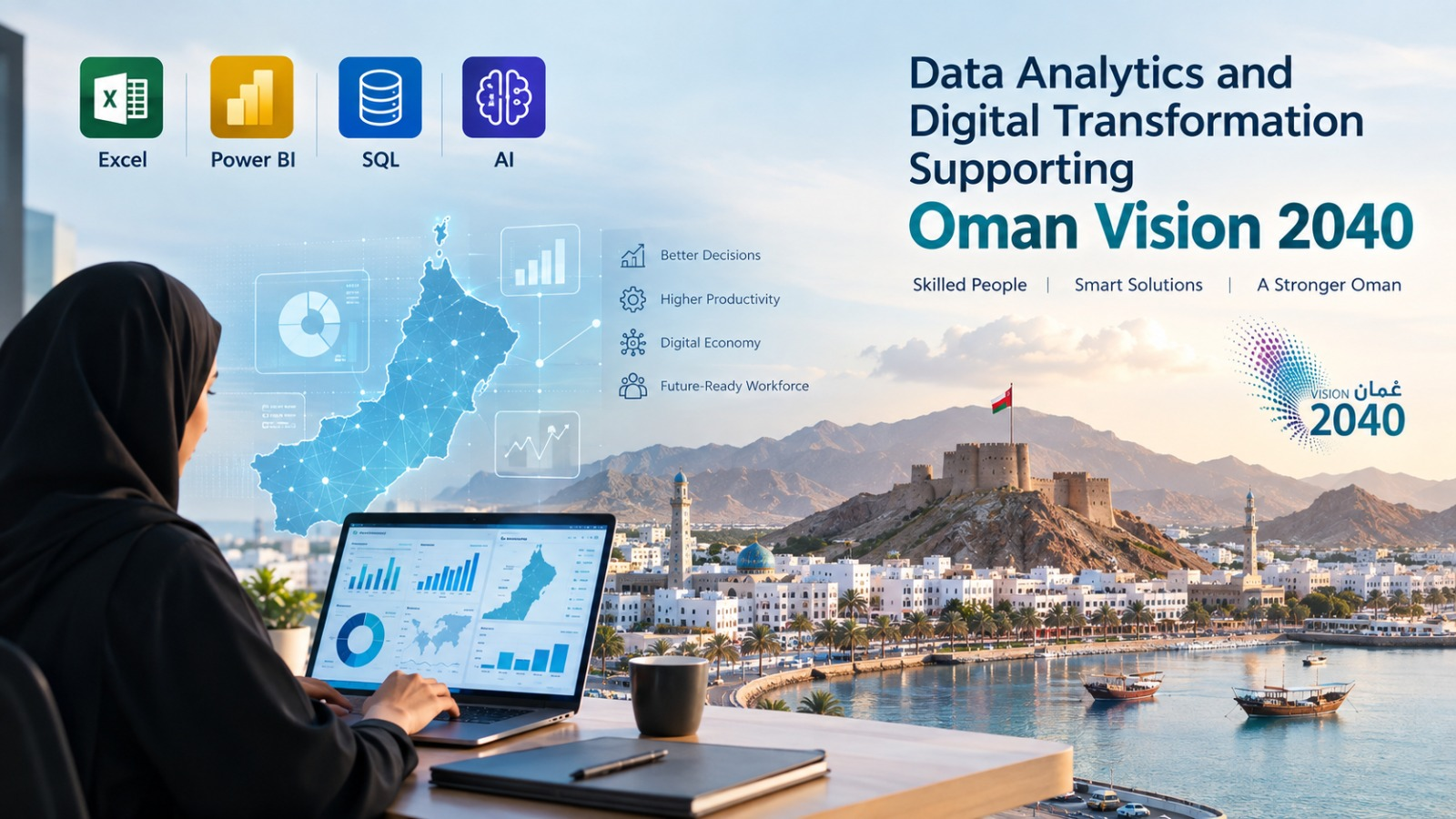
Oman Vision 2040 places strong emphasis on building national capabilities, digital transformation and a skilled workforce. For professionals, practical skills in data analytics, Excel, Power BI, SQL, automation and AI can help them prepare for a more digital economy.
What does Oman Vision 2040 mean for digital skills?
Oman Vision 2040 is driving the country toward a more diversified, knowledge-based and digitally enabled economy. Digital transformation is not only about adopting new technology. It also requires people who can use data, digital tools and emerging technologies effectively.
Oman's National Digital Economy Program supports this direction through initiatives focused on digital transformation, digital industries, talent development and digital skills. The Digital Industry Program also identifies skills development and workforce readiness as key areas of focus.
For professionals, this means one thing is becoming increasingly important: building practical digital skills that can be applied to real business problems.
Why are digital skills important for Oman Vision 2040?
Digital skills are important because technology alone cannot transform an organisation. Businesses and government organisations need people who can work with data, understand digital tools, automate repetitive work and turn information into useful decisions.
Oman's digital transformation agenda also connects technology with economic diversification, productivity and workforce development.
Professionals who can combine business knowledge with practical digital skills can therefore become more valuable as organisations adopt new systems and data-driven ways of working.
What digital skills will matter for professionals in Oman?
The right skills will vary by role and industry, but several areas are especially useful for modern business professionals.
| Digital skill | Why it matters | Common business use |
|---|---|---|
| Advanced Excel | Data analysis and reporting | Finance, sales, HR, operations |
| Power BI | Dashboards and data visualisation | Management reporting |
| SQL | Working with business databases | Data analysis and reporting |
| Data Analytics | Turning data into decisions | Business strategy |
| Python | Automation and advanced analysis | Data and process automation |
| AI | Productivity and intelligent workflows | Analysis, content and automation |
| Power Platform | Business process automation | Apps and workflows |
The goal is not to learn every technology at once. Professionals should choose skills based on their current role, career direction and the problems they want to solve.
1. Advanced Excel remains an important business skill
Excel is still widely used for reporting, analysis, budgeting, forecasting and operational work. But the Excel skills required in modern workplaces go beyond basic formulas.
Professionals can build stronger skills by learning:
- XLOOKUP and advanced formulas
- PivotTables and PivotCharts
- Power Query
- Data cleaning
- Dynamic arrays
- Dashboard creation
- Automation
- AI-assisted Excel workflows
The biggest advantage comes when Excel is used to reduce manual work rather than simply create spreadsheets.
For example, instead of manually combining multiple monthly reports, a professional can use Power Query to build a repeatable process that refreshes the data with much less manual effort.
2. Power BI can turn business data into decisions
Power BI is useful when organisations need to bring data from different sources into interactive dashboards and reports.
A finance team could use Power BI to monitor revenue and expenses. A sales team could track targets and regional performance. An operations team could monitor production, inventory or delivery metrics.
The skill is therefore not simply “how to create a dashboard.”
A strong Power BI professional should understand:
- Data preparation
- Power Query
- Data modelling
- Relationships
- DAX
- KPI design
- Data visualisation
- Power BI Service
- Report sharing and security
These skills can help organisations move from static reports toward more consistent, data-driven decision-making.
3. SQL helps professionals work directly with data
As organisations store more information in databases, knowing how to retrieve and analyse data becomes increasingly useful.
SQL allows professionals to ask business questions directly from structured data.
For example:
Which products generated the highest sales last quarter?
Which customers have not purchased recently?
Which region has the fastest growth?
SQL skills such as filtering, grouping, joins, subqueries and window functions can help analysts answer these questions more efficiently.
SQL becomes even more useful when combined with Excel or Power BI.
4. Data analytics connects technology with business decisions
Data analytics is more than learning a software tool.
A good analyst needs to understand the business question, find the right data, clean it, analyse it and communicate what the result means.
A practical analytics workflow looks like:
Business question → Data → Cleaning → Analysis → Visualisation → Insight → Action
This is why data analytics can be valuable across sectors such as finance, manufacturing, logistics, retail, energy, healthcare and government.
For Oman, where digital transformation and economic diversification are important national priorities, professionals who can connect data with business decisions can play an important role in this transition.
5. AI and automation are becoming part of everyday work
AI is changing how professionals search for information, analyse data, write content and automate repetitive tasks.
But AI skills should not replace core digital skills.
A professional who understands Excel, data analysis or business processes can use AI much more effectively because they can check the output and understand whether it makes business sense.
Useful areas include:
- AI-assisted data analysis
- Microsoft Copilot
- Prompt writing
- Workflow automation
- AI-assisted reporting
- Document processing
- Business process automation
The future is less about choosing between people and AI and more about helping people use AI responsibly and effectively.
Which industries in Oman can benefit from digital skills?
Digital skills can support many sectors involved in Oman's economic diversification.
| Sector | Useful digital skills |
|---|---|
| Energy & Oil and Gas | Data analytics, Power BI, automation, AI |
| Manufacturing | Excel, Power BI, SQL, process automation |
| Logistics | Data analytics, dashboards, SQL |
| Banking & Finance | Excel, Power BI, SQL, data analysis |
| Tourism | Reporting, analytics, customer data |
| Healthcare | Data analysis, dashboards, digital systems |
| Government | Data analytics, digital transformation, AI |
| Retail | Excel, Power BI, customer analytics |
Oman's digital transformation framework identifies sectors including energy, manufacturing, logistics, tourism, agriculture and fisheries as areas where digital transformation can support economic diversification.
That makes digital skills relevant beyond traditional technology jobs.
How can professionals prepare for Oman Vision 2040?
The best approach is to build skills progressively rather than trying to learn everything at once.
Step 1: Start with your current role
Ask:
What takes the most time in my current job?
If you spend hours preparing reports, Advanced Excel and Power Query may be a useful starting point.
If you prepare management reports, Power BI may provide more value.
If you need data directly from databases, learn SQL.
Step 2: Build one strong core skill
Choose one skill and become comfortable applying it to real work.
For example:
Excel → Power Query → Power BI
or:
SQL → Data Analytics → Power BI
Step 3: Add AI to your existing skills
Once you understand the basics, use AI to improve productivity.
For example, an Excel professional can use AI to explore formulas and automate repetitive tasks while still checking the results.
Step 4: Work on real business projects
Certificates can show that you completed training, but practical projects demonstrate what you can actually do.
Build projects such as:
- Sales performance dashboard
- Financial reporting dashboard
- Employee analytics report
- Inventory analysis
- Customer analysis
- Automated monthly report
Step 5: Keep improving
Digital transformation will not stop at one technology.
Professionals should develop a habit of continuous learning as tools, business processes and job requirements change.
Digital skills vs traditional skills: what should professionals focus on?
The answer is not to abandon traditional business knowledge.
The strongest professionals will often combine both.
| Traditional strength | Digital skill | Result |
|---|---|---|
| Finance | Excel + Power BI | Better financial reporting |
| Sales | CRM data + analytics | Better sales decisions |
| HR | Excel + analytics | Better workforce reporting |
| Operations | Power BI + automation | Faster operational reporting |
| Marketing | Analytics + AI | Better campaign decisions |
| Management | Dashboards + data literacy | Better decision-making |
Technology becomes valuable when it improves the work someone already understands.
What are the biggest mistakes professionals make?
Trying to learn too many tools
Learning Excel, SQL, Python, Power BI, AI and every new platform at the same time often leads to shallow knowledge.
Start with one skill that directly supports your role.
Focusing only on certificates
A certificate can be useful, but practical ability matters too.
Build something. Analyse a real dataset. Create a dashboard. Automate a repetitive task.
Learning tools without understanding business problems
Knowing where a Power BI button is does not make someone a strong analyst.
The real skill is knowing what to analyse, why it matters and what action the business should take.
Ignoring communication
A good analysis is not useful if nobody understands it.
Professionals should learn to explain findings clearly to managers, clients and other teams.
How can companies prepare their workforce for digital transformation?
Companies should treat digital training as part of workforce development rather than a one-time software workshop.
A practical corporate training programme can begin with a skills assessment, identify common workflow problems and then build training around actual business data.
For example, a company could combine:
Advanced Excel → Power BI → Data Analytics → Automation → AI
This approach helps employees learn skills that connect directly to their daily work.
What is the future of digital skills in Oman?
The future of digital skills in Oman will increasingly combine data, AI, automation and business knowledge.
Oman's national programmes already focus on developing digital capabilities, supporting digital industries and preparing the workforce for digital transformation.
For professionals, the practical takeaway is simple: do not wait until a new technology becomes a job requirement. Start building the skills that allow you to work effectively with data and digital tools today.
Frequently Asked Questions
What are the most important digital skills for Oman Vision 2040?
Important digital skills include data analytics, AI literacy, advanced Excel, Power BI, SQL, automation, cybersecurity and other technology skills. The right combination depends on the professional's industry and role.
What is the role of digital skills in Oman Vision 2040?
Digital skills support Oman's wider goals around digital transformation, economic diversification, workforce development and a knowledge-based economy. Skilled professionals are needed to implement and manage these changes.
Is Power BI a useful skill in Oman?
Yes. Power BI can help professionals analyse business data, create dashboards and improve management reporting. It can be particularly useful for finance, operations, sales, HR and analytics teams.
Should professionals in Oman learn Excel or Power BI first?
Excel is usually the easier starting point for beginners because it is widely used for everyday business work. Power BI becomes especially valuable when professionals need interactive dashboards, multiple data sources and recurring management reports.
Is SQL useful for data analytics jobs in Oman?
Yes. SQL is a core data skill because it allows professionals to retrieve, filter and analyse information stored in databases. It works particularly well alongside Excel and Power BI.
What is the best way to learn digital skills?
Start with one skill connected to your current role, practise it with real business problems and then build complementary skills. Practical projects are often more useful than learning software features without context.
What digital skills should businesses train their employees in?
Businesses can consider Excel, Power BI, SQL, data analytics, AI, automation and digital productivity tools based on their workforce needs. Training should focus on actual workflows and measurable business outcomes.
How does AI fit into Oman Vision 2040?
AI is part of Oman's broader digital transformation and advanced technology agenda. Developing AI capabilities requires not only technology adoption but also people with the skills to use, manage and apply AI responsibly.
Can non-technical professionals learn data analytics?
Yes. Data analytics is not limited to programmers. Professionals in finance, HR, sales, operations and other business functions can learn tools such as Excel, Power BI and SQL to work more effectively with data.
Why are future skills important in Oman?
Future skills help professionals adapt to changes in technology, jobs and business processes. They also support Oman's broader focus on developing national capabilities and preparing the workforce for a changing economy.
Prepare for the next stage of digital work
Oman Vision 2040 is creating a stronger focus on digital transformation, workforce capability and economic diversification. Professionals who build practical skills in Excel, Power BI, SQL, data analytics, automation and AI can be better prepared for the changing workplace.
For organisations, the opportunity is equally important: developing digital skills within teams can help turn technology investment into measurable improvements in productivity, reporting and decision-making.
If you are looking to build practical digital skills using real business scenarios, explore TechnoExcel's training programmes for Advanced Excel, Power BI, SQL and Data Analytics.
This topic is covered in the Data Analytics course. Sessions are live, practical and taught with real business data — a natural next step if this article matches what you are working on.